What actually works to get rank on Google?
Here’s a conversation we’ve had more times than I can count. A business owner calls, a little frustrated, sometimes a little embarrassed, and says something like: “We’ve been posting blogs for months. We did the meta descriptions. We hired someone for backlinks. And we’re still stuck on page four of Google.”
If that’s you right now — you’re not doing anything wrong, exactly. You’re just doing your SEO in the wrong order, or chasing advice that stopped working a while ago and nobody bothered to tell you.
The checklist version of SEO doesn’t really exist anymore
A lot of what’s floating around online still treats search engine optimization like a recipe. Fifteen hundred words, target keyword five times, ten backlinks, done. And look — that used to move the needle on search rankings, more or less. It doesn’t anymore, not really. Google’s algorithm got a lot better at telling the difference between a page written to game organic search results and a page written because someone actually knew what they were talking about.
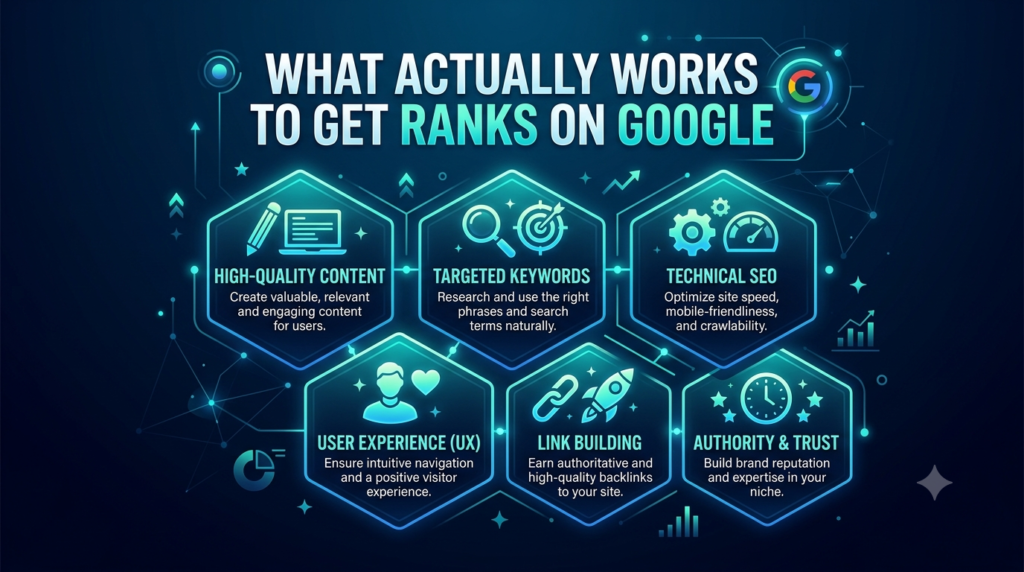
That said, technical SEO still matters. A lot. If your site’s slow, or it’s a mess on mobile, or half your internal links are dead, or your site structure is confusing — none of the “good content” advice in the world is going to fix that. Get the boring stuff — page speed, mobile responsiveness, crawlability — sorted first. Then worry about the rest.
What actually separates page one from page four
Search intent matters more than keyword density. If someone types “best accounting software for freelancers,” they don’t want an essay on the history of accounting software (obviously). They want a comparison, fast, so they can pick one and get back to work. Before we do keyword research or write a single word for a client, we try to figure out what the searcher is actually trying to do — buy, compare, fix, learn — because that intent shapes the entire content strategy behind the page.
Content depth beats word count, most of the time. One sprawling 3,000-word post trying to cover an entire topic usually loses to a handful of shorter, tightly focused pages that link to each other and each answer one specific question well — what a lot of SEO agencies call topic clusters or pillar content. Google reads a site kind of like a person would — if you clearly know a subject across several pages, that reads as more authority and credibility than one giant article trying to do everything at once.
Trust signals aren’t just link building anymore. Backlinks still count, sure. But things like how consistently you publish, whether your on-page SEO and site architecture are actually logical, and — this one’s easy to forget — how real users behave once they land on your page. Do they stick around? Scroll? Click through to another page? Or bounce right back to the search engine results page in four seconds? That user behavior tells Google something too, quietly, in the background, and it factors into your rankings whether you realize it or not.
What we do differently at SEO HIVEE (honestly, nothing magic)
We’re not going to tell you we’ve cracked some secret algorithm nobody else knows about. Anyone who says that is either exaggerating or about to sell you a digital marketing package that gets your site penalized six months later. What we actually do is slower and, frankly, less exciting to describe:
We start with a full technical SEO audit, every time, even when a client is impatient to skip straight to content marketing. Skipping it just means building your organic traffic strategy on a bad foundation. Then we dig into the real questions people are typing — not just the high-volume keywords a tool spits out, but the specific, sometimes clumsy phrasing people actually use when they’re stressed and trying to solve something right now. From there we build content and internal linking that helps first and tries to rank second, because in our experience that’s the order that actually sticks, instead of spiking for a month and then quietly sliding back down the search results.
And when something in the strategy isn’t working, we say so. We’re not going to keep charging you for SEO services that have clearly stalled out just because it’s easier than having that conversation.
A quick gut check before you hire any SEO agency
Ask yourself a few honest questions:
- Does your homepage actually load fast on mobile, or are you assuming it does?
- If you search your main keyword right now, are the top-ranking pages genuinely better than yours — or just older and more trusted by Google?
- Are you publishing content because it helps someone, or because you read “consistency matters” somewhere and took it literally?
- Do you actually know which pages bring you organic traffic and leads, or are you kind of guessing?
If a couple of those stung a bit, don’t worry — that’s most businesses, not just yours. The nice thing about SEO, compared to a lot of digital marketing problems, is that it’s genuinely fixable once you know what’s actually broken. It just takes some patience, the right keyword and content strategy, and someone willing to do the unglamorous parts first.
Where to go from here
SEO isn’t really a switch you flip — it behaves more like compound interest, slow at first and then not. The websites that end up winning long-term search rankings are usually the ones that stayed consistent and honest about what their audience actually needed, not the ones that found some clever shortcut or quick-fix SEO trick.
If you’d like a second opinion on where your site actually stands — technically, in terms of content, or in your local SEO presence — SEO HIVEE offers a straightforward SEO audit and digital marketing consultation. No scare tactics, no jargon for the sake of it, just an honest look at what’s working, what isn’t, and what to fix first to actually grow your organic search traffic. Reach out, and let’s figure it out together.
Leave a Reply